
The Invisible Gear: How to Hack Studio-Grade Immersion on a Budget

1. Introduction: The Myth of the Multi-Million Dollar Frame
In my years navigating both the halls of academia and the grit of independent sets, I have encountered a persistent myth: that a "cinematic" look is a luxury reserved for those with a studio-sized bank account. Aspiring creators often look at a smartphone-shot masterpiece and wonder how it manages to stand toe-to-toe with a million-dollar production. The secret isn't found in the gear bag; it’s found in the execution.
Immersion is a craft of "invisible" techniques. By mastering the fundamental principles of structure, light, and movement, you can bridge the gap between a simple video and a professional production without spending a dime extra on equipment.
2. The Skeleton: Why Structure Trumps Spectacle
Immersion begins long before the camera rolls, with the narrative "skeleton." Whether you are utilizing the timeless Three-Act Structure, the mythic Hero’s Journey, or Blake Snyder’s Save the Cat beats, a solid framework is your ultimate budget-saver. It prevents the most expensive mistake in filmmaking: aimless shooting.

For episodic creators, I highly recommend Dan Harmon’s Story Circle, which distills character-driven transformation into eight repeatable steps:
You (A character in their zone of comfort)
Need (But they want something)
Go (They enter an unfamiliar situation)
Search (Adapt to it)
Find (Get what they wanted)
Take (Pay a heavy price)
Return (Back to the familiar)
Change (Forever altered).
However, a skeleton is useless if you cannot communicate it to your team or a producer. This is where the Logline—the "One-Sentence Sell"—becomes vital. Use the industry-standard formula:
[Protagonist] must [achieve goal] before [major consequence/stakes] because [inciting incident/unique premise].
"It’s the essential skeleton every great story needs."
3. The Silent Character: Harnessing "Available" Environments
In the indie world, your location must do more than just exist—it must act as a "silent character." A well-chosen environment conveys mood and history that dialogue simply cannot reach.
As a creative strategist, I encourage you to view "found" light as your most valuable asset. Utilizing the Golden Hour or Blue Hour provides a high-end aesthetic for free. Specifically, the
Blue Hour is a strategic goldmine for the indie budget; it allows you to capture a moody, ethereal atmosphere without the need for expensive blue gels or complex lighting rigs.
When scouting your "silent character," evaluate these four critical considerations:
Aesthetics: Does the visual tone align with the script’s soul?
Logistics: Is it accessible for your crew, parking, and equipment?
Sound: Are there external interferences like traffic or flight paths that will ruin your takes?
Light: How does the natural light move through the space across the day?
4. Psychological Framing: Power Moves with Camera Angles
Camera angles are a form of visual psychology. Framing choices like the Rule of Thirds—placing subjects on the intersections of a 3x3 grid—create balance and narrative flow that draws the viewer's eye exactly where you want it.
Take the classic "Detective Interrogation" scenario:
By shooting a suspect from a High Angle, you make them appear smaller and dominated, emphasizing their nervousness.
By shooting the detective from a Low Angle, you reinforce their authority, making them appear larger and more intimidating.
This power struggle is communicated to the audience before a single line of dialogue is delivered. "Think of angles as a form of visual punctuation—they add emphasis, tone, and rhythm to your story."
5. Invisible Immersion: The Magic of Foley and Sound Diegetics
Sound is the "invisible art" that makes a world feel real. To build immersion, you must master the balance between Diegetic Sound (what the characters hear, like a door creak) and Non-Diegetic Sound (the score or narration meant only for the audience).
Foley is the secret weapon for high-fidelity texture on a shoestring budget. You don’t need a studio when you have organic ingenuity:
Breaking bones: Snap celery stalks near the mic.
Rain: Pour uncooked rice onto a drum or metal sheet.
Fire: Crinkle cellophane.
Footsteps: Walk on gravel, wood, or dirt in a controlled environment to add "weight" to your characters.
6. Dynamic Movement: The Dolly Dance on a Shoestring
Static shots can feel stagnant, but movement creates a fluid, immersive experience. The Dolly (or Track) shot involves physically moving the camera to change perspective, but it must be motivated by the story.
Consider a high-intensity sequence like the one depicted in Scene 12, Shot 27 of our storyboards. As a character strains to climb a treacherous cliff during a heavy rainstorm, we don't just watch from afar. We use a Crane Up and Dolly In to move closer to her face as she gasps, "Hold on! I'm almost there!" This movement, combined with the Foley sound of a rope snapping, creates a visceral sense of danger that a static shot could never achieve.
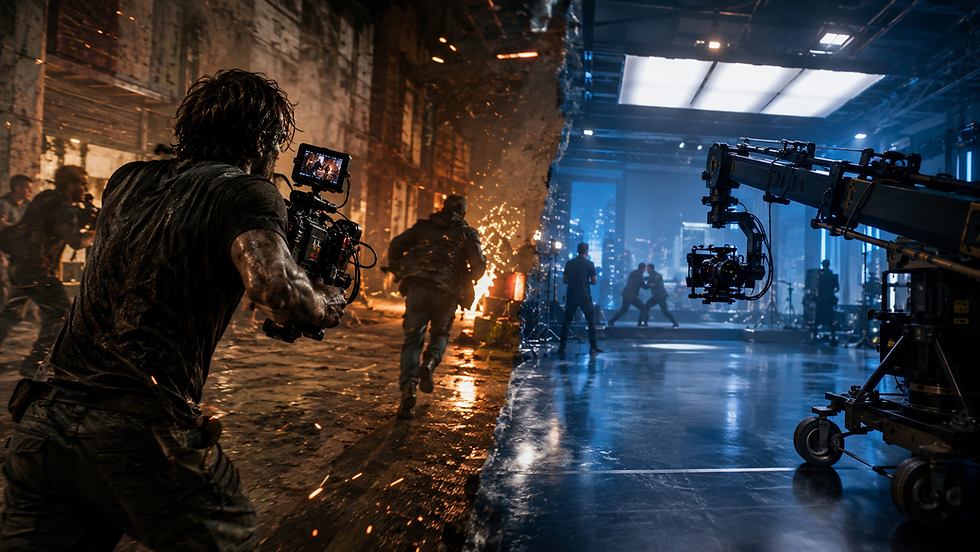
If physical tracks aren't an option, use Handheld movement. It introduces a sense of urgency, realism, and chaos that puts the audience directly into the character's shoes.
7. The 180-Degree Rule: Maintaining the "Axis of Action"
To keep the audience from being pulled out of the world, you must respect the 180-Degree Rule. Establish an invisible "axis of action" between two subjects. By keeping your camera on one side of this line, you ensure consistent screen direction.
If you "break the rule" and cross that line without a transitioning shot, the characters will appear to suddenly "flip" positions. This creates a jarring, disorienting effect that shatters the geography of the scene. For the technical operator, the instruction is clear: Never cross the axis unless you are intentionally trying to signify a psychological breakdown or total chaos.
8. Conclusion: From Creator to Operator
Mastering cinema is a transition through three distinct tiers of creative strategy. You begin with Foundations, learning the language of clear prompting to turn ideas into visuals. You then move into Intermediate workflows, building repeatable systems like AI-assisted storyboarding and shot listing. Finally, you reach the Advanced level, where you become an operator of scalable studio pipelines, turning your creativity into a system that produces consistent, professional results.
Which of these "invisible" techniques will you use to transform your next scene from a simple video into a cinematic world?
Comments